Séchard Printing House
Illusions perduesThe Séchard Printing House is a cramped, aging workshop in Angoulême whose obsolete equipment and vulnerable finances shape the lives of its owners and workers. Passed from Jérôme-Nicolas Séchard to David Séchard, it becomes both the setting for David and Lucien de Rubempré’s early companionship and an object of competition: control of a local press means control over a scarce means of printing and public influence.
Location and Printing Technology
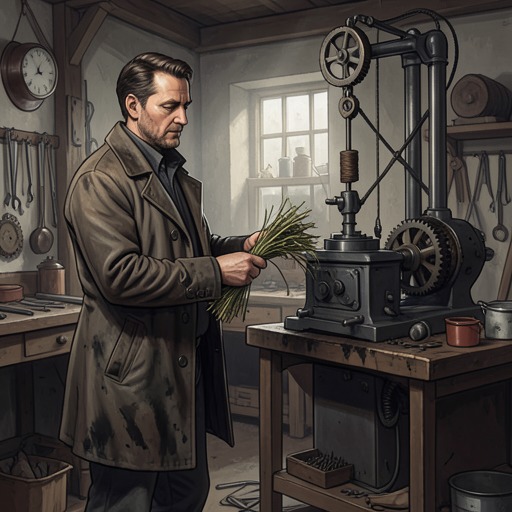
The establishment stood where Beaulieu Street opened onto Place du Mûrier, in a house that had served the printing trade since near the end of the reign of Louis XIV. Its technology belonged to an earlier era. Small provincial shops had not yet adopted Stanhope presses or rollers for distributing ink; the Séchard workshop still used wooden presses, leather ink balls, and a stone bed, or marble, on which the type form and paper were placed. A pressman applied ink by hand, while compositors selected letters from the many compartments of their cases. The description makes the shop’s tools more than antiquarian details: this was a working system whose physical limits determined how printing was done.
The narrator sets the old machinery against the later spread of mechanical presses, while acknowledging that the older process had produced celebrated books. Jérôme-Nicolas’s attachment to the tools is described as almost superstitious. The contrast gives the workshop a double character: it is technologically behind the times, yet it remains part of the material history of printed literature. Its traditional equipment is not simply discarded scenery; it continues to organize the work and the fortunes of the people inside it.
Building and Working Interior
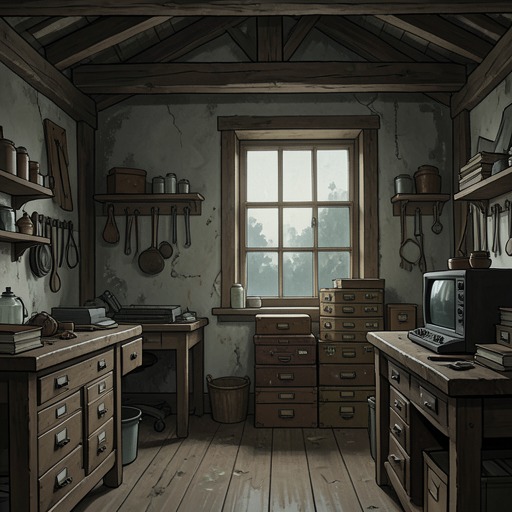
The street entrance descended several steps into a vast ground-floor workshop, since the floor lay below the level of the road. A worn window faced the street, and a large frame admitted light from the courtyard. Curious customers often entered through the glazed shopfront to watch the printing trade, passing through the workers’ space rather than taking the more convenient passage to the master’s office. The layout turned production into a spectacle, but an awkward one: visitors could catch themselves on benches, paper, cases, or the iron bars bracing the presses, to the amusement of the workers.
Sheets hung from cords beneath the ceiling, forming rows of suspended paper. The cases, presses, damp paper, and piles of type crowded the routes through the workshop. At its far end, two small rooms projected into the courtyard: one served the foreman, the other the master printer. The courtyard itself was marked by trellises, while a dilapidated lean-to against the dividing wall housed the soaking and shaping of paper. At a sink, workers washed the type forms before and after printing; ink mixed with household water ran away from the shop. A kitchen and woodshed flanked the lean-to, placing domestic and industrial activity in immediate proximity.
The upper floor extended that mixture of work and household life. Its first room served as both entrance hall and dining room, sparsely furnished and often crowded with paper; meals could be set among the bundles. The adjoining bedroom retained old tapestries and furniture from the previous master, while the salon had received an incomplete modernization before Madame Séchard died. Jérôme-Nicolas, seeing no return in improvements that brought no income, left the work unfinished. The neglected rooms and the clutter below make the building’s commercial austerity visible in its daily surroundings.
Jérôme-Nicolas and David Séchard
Jérôme-Nicolas had begun as a pressman, known in the workers’ jargon as a Bear for the back-and-forth movement between ink and press. Over time, an eye for costs and a suspicious, practical command of the trade made him an exacting employer and a miserly owner. The printing house had accumulated customers and assets, but his attention to profit shaped the place more strongly than investment or modernization. He sent David to Paris to learn advanced typography, yet expected him to save money there rather than depend on paternal support.
By late 1819, David returned from Paris trained in the trade and better educated, only to find that taking over the establishment did not mean receiving it on generous terms. His father treated the transfer as a bargain between opposing interests: Jérôme-Nicolas wanted to sell dearly, while David needed to buy cheaply. During the handover, the old printer presented an inventory of the equipment, calling the shop a jewel even as its inherited machinery and worn premises told a less flattering story. The printing house thus embodies the strained father-son relationship in material form: it is both David’s professional responsibility and the asset his father tries to value to his own advantage.
David, Lucien, and the Shop’s Business
The shop’s weak commercial position contrasted sharply with that of its established rival, the Cointet Brothers Printing Works. The Séchard business brought in only about three hundred francs a month before wages, taxes, rent, and other expenses; David was left with roughly a hundred. The rival firm earned far more and owned the department’s sole newspaper. David and Lucien were absorbed in intellectual work and did not modernize the business by replacing type, acquiring iron presses, or seeking new books to print. The Cointet brothers, knowing David’s character, sent him minor local printing work and allowed his shop to persist in modest circumstances rather than risk its passing into the hands of a more formidable competitor.
The workshop is also where David’s friendship with Lucien becomes a practical bond. When they met again as former schoolmates, Lucien was close to despair in poverty. David offered him forty francs a month and the chance to learn the foreman’s trade, although he had no real need of an additional foreman. The offer rescued Lucien from immediate desperation and renewed their friendship. In the printshop, their different ambitions meet: Lucien pursues literary fame, while David’s intellectual gifts incline him toward scientific and practical questions. Each helps the other imagine a future beyond the narrow prospects offered by the workshop’s present business.
Ownership, Politics, and Afterlife
The press’s modest scale did not make it politically insignificant. In Angoulême and the surrounding district, the Cointet firm’s command of printing and newspaper publication concentrated influence in a few hands. Pierre Petit-Claud argued that a Liberal committee in L’Houmeau should acquire the Séchard establishment so the opposition could have a newspaper of its own. The proposed funding would leave the owner dependent on a loan, turning purchase of the physical business into a means of controlling its proprietor as well as its presses. Cérizet was identified as the person who might uncover David’s whereabouts and take charge of the printing house.
Later, Petit-Claud brought David and Ève an offer of twenty-two thousand francs in cash from Cérizet. David objected that he had promised not to establish a newspaper in Angoulême; Petit-Claud answered that a successor could do so, and that the proposed newspaper could be based in L’Houmeau. David accepted the sale, and Cérizet paid that evening, assuming responsibility for the final quarter’s rent. The transaction gave the old workshop a new owner, but did not end its political and commercial entanglements: Cérizet was later forced by Petit-Claud’s successor to sell his Angoulême printing business and sought a new livelihood elsewhere.
The Séchard Printing House therefore links the intimate scale of a family workplace to the larger machinery of publishing and local power. Its wooden presses, congested rooms, and improvised paper-making shed establish the physical conditions of the trade; its weak accounts expose the disadvantage of remaining technologically and commercially stagnant; and its successive transfers show why even a provincial shop could matter to rival businesses and political factions. For David and Lucien, it is first a place of labor and mutual support, then part of the struggle over who can print, publish, and shape public opinion.